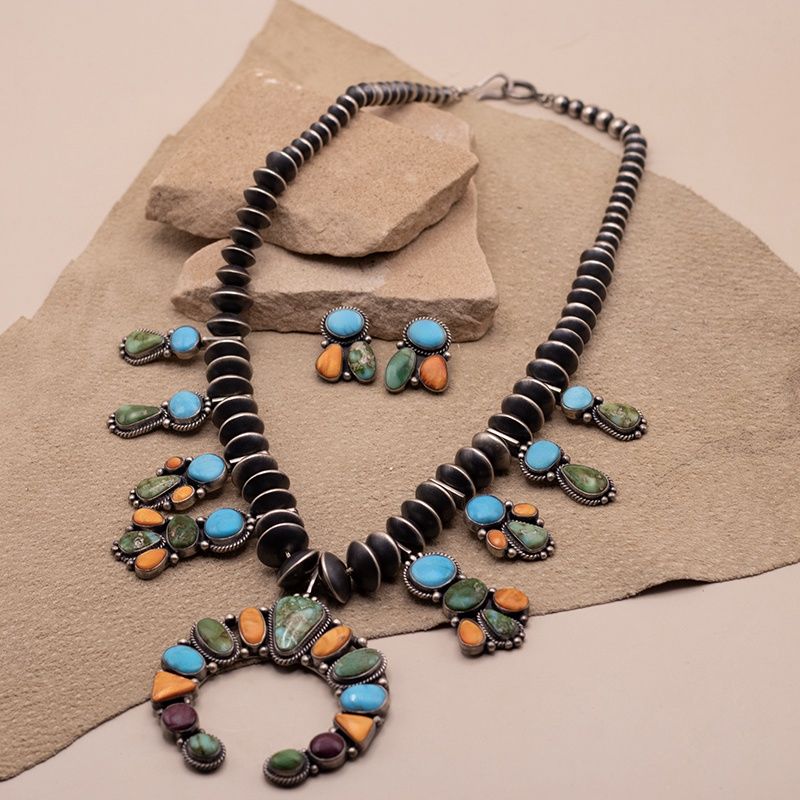
Multicolor Squash Set
Share
SKU ANA1975
$7,500.00
In stock
1
Have questions?
Multicolor Squash Set
Share
Product details
Small-to-medium-size, Navajo-handcrafted single-strand squash blossom necklace features sky blue, green, orange and purple in a multi-colored display of southwestern jewelry culture. The dark oxidation of the disc/ saucer-shaped sterling silver beads and twisted rope wire framing each stone/ piece creates a dramatic contrast with the vibrant Sonoran gold, Kingman turquoise and purple and orange spiny oyster shell. Strung on foxtail.
Naja measures approximately 2.5" x 2.5" with a 2.5" drop. Measurements: 22" long. Matching earrings measure 1" x 3/4". *All measurements are approximate
Material: Sterling silver, Sonoran gold turquoise, Kingman turquoise, purple spiny oyster shell and orange spiny oyster shell. Sonoran Gold Canyon Turquoise is an interesting turquoise from Senora, Mexico, near Nogales, Arizona, and its neighbor: Nogales, Mexico, which is the northernmost point in all of Mexico. The series of mines bearing this name are on several sites contingent to the American border. Very little hard natural material has been mined here. Most has needed stabilizing to be useful. The high-grade natural material is a medium blue or often medium lime green to darker green. This is usually accompanied by iron pyrite, or brown matrix. The high-grade turquoise from this mine is rare and is considered both esoteric and valuable. Shell: Spiny Oyster Shell or Spondylus shells are, indeed, very spiny, but the polished product looks very smooth the most used Spondylid Bivalve shell colors include orange, reds, and purples and may include distinct striations and color variations. In the American Oceans, the Spondylids occur along the North American coasts, as far north as North Carolina, on the Atlantic Coast, and northwestern Mexico Red Spiny Oysters grow in deeper water from 35ft-300ft, making them more difficult to find and harvest. Squash Blossom definition: While squash blossom imagery can be found in petroglyphs (rock art) that pre-date European contact in the Southwest, Dubin said the squash blossom necklace was created in the late 1870s or early 1880s after the native people of the area contacted Spanish Mexicans. The Navajo, it is believed, were the first tribe to adopt the design, but by the early 1900s, the art form had spread to neighboring tribes, including the Zuni and the Pueblo. While the entire necklace has taken its name from one type of bead, the classic squash blossom necklace has three distinct parts: the plain round beads; the round beads Naja.